Lucie Zhang and Makia Samba – no ordinary lovers in Jacques Audiard’s Les Olympiades

The complexities of the now – where cultural and sexual fluidity creates a hyper-real feast that promises the world, but in this attempt, delivers only a dull ache in the final show down – and this dull ache, if any sensation at all, is the way we chart our lives these days. Jacques Audiard’s Les Olympiades, Paris 13e / Paris, 13th District (2021) opens with a searching shot across a nighttime skyline: factories with smoke pouring out, large expanses of sprawling inhabited land on which featureless massive apartment blocks present themselves. This eye is not the god-eye view of Wings of Desire (1987), nor the eye of the vitriolic, Enter the Void (Gaspar Noé, 2009), no, it is the eye of a lesser being, the mechanical ‘us’. Just like a drone in search of a story; this eye finally settles on scanning the windows of one such lifeless apartment block to reveal a few illuminated inhabitants, those of switched-on machines and TV watchers. 

We live in a world of disillusionment. 

Enter into the life-erotic, that of Émilie Wong’s (Lucie Zhang); we first see her lazing on a couch, naked, her breasts framing her more than the camera frames the shot, as in, that is all we see – her breasts, her nakedness, her otherness. This striking opening sequence will remain the film’s highlight: Émilie is singing a song in Mandarin, the lyrics of which have not been translated…her voice is lilting and haunting, an effect from one of those kitschy Karaoke microphones – the kind with built-in speakers that reverberates and echos when you sing into it. She is then joined by a guy, black, handsome, amazing head of hair (short Afro), also naked; we’d heard his voice first, off-screen, asking whether she wanted some yoghurt. We’re unsure of the relationship between these two…are they lovers? The kind that share their bodies as well as a dwelling and food? Or, is she a whore, and he, her pimp? Or, her customer?

This scene, in fact, is a flash forward, and as an audience, we get to begin again, and enter into a series of episodic and overlapping stories ‘from the beginning’ – loosely following Émilie’s life in Paris, her exchange with Camille (Makia Samba), the guy from the opening sequence, before handing the baton, so to speak, over to Nora (Noémie Merlant, you would know her from Portrait of a Lady on Fire (2019)); her story is one of mistaken identity, having been taken for an online porn-star Amber Sweet. 

Amber Sweet and her easy doppelgänger

All through the film, there is a strong sense of the frantic and the mundane in all of their stories. We are continuously reminded that we live in a world of disillusionment; and although this film can be seen as a fresh new kind of love story; dripping in ennui, it isn’t really that at all. Émilie’s dance of joy can be understood as a flight into freedom or exhilaration, I’m thinking specifically of Les Amants du Pont-Neuf (1991), although you see it and understand its intended meaning, but unlike Les Amants, I can’t feel it. 

The euphoria of being alive

Audiard’s exploration into the flaws of human connection hasn’t moved far from his most well-received film to date, A Prophet (2009) which launched the career of the talented Tahar Rahim, but this latest film doesn’t deliver that kind of fatalist but euphoric quality of The Beat That My Heart Skipped (2005) or the deterministic thrust of Read My Lips (2001). The fresh and naturalistic performance from relative newcomer Lucie Zhang, however, is captivating; and there are some moments of this film that is beautifully shot too. The story is in part based on the graphic novels by American cartoonist, Adrian Tomine

The self-crowning of Lucien

In the literary world, everyone is someone, until you are not. And please, don’t even try to be that someone, for this is a gated guild that an invitation to join is not always what it seems. With a little first-hand experience of such a world, I found it is even more important in this universe  than in the business world, of who you know and who your influencers are, rather than necessarily what you write, and even less so, the quality of your writing. 

Illusions perdues / Lost Illusions (2021) directed by Xavier Giannoli is a luminous affair, coloured by a kind of self-illumination of the chosen and the elite; and with this fantastical circus, the self-proclaimed patrons of the arts dance in their finest trickery to push through the receding darkness of what graces they have bought. Cretinous journalism indeed; we are in the land of the jackals and the wolves; with a paddling of ducks to sing or sink. 

Fragile is the heart, but thick is the skin

I have not read Balzac’s book, Illusions perdues, which was written in three parts between 1837 and 1843, but I can immediately galvanise its context in our current times. The film tracked two of the three volumes, and to do this justice, has a running time of 2 hours and 48 mins (actually, the running time differs when you seek out different websites, but I am pretty sure that the one shown at the AFFF is the longer cut), but the tempo in which the story builds, buoyed by meticulous art direction; fine acting and a pacy script; paints the screen with resplendent costumes haloed in a kind of golden hue; form a raft on which the viewer can only breath the whole thing in, in one single glorious take. There isn’t much room for contemplation; which perhaps was how it must have felt for the doe-eyed innocent Lucien, the hero cum anti-hero of the story. Beautifully played by Benjamin Voisin, (last seen as the young lover in Ozon’s Summer of ‘85 (2020)), a young love-lorn self-published poet from Angoulême who followed his love interest, a lonely but wealthy patron of his “Marguerite” poems, Louise de Bargeton (Cécile de France), to seek out a writerly life in Paris. Heartbreak and destitution, fame and fortune, and finally the fall of the unguarded all came in a blink of an eye. 

The Lucien of nature, of writing, and thoughts

There is little else to do but for us to continue to dream of Lucien, from far away; we still wish for his innocence and success; we still pray for his dreams and talent to be taken for what they are. But, this is not the life illuminated, it is a life of lost illusions; where the dreamic persists only within the dunk of a madeleine.

Xavier Dolan as writer / friend of Lucien‘s, Nathan d’Anastazio

There were many fine support casts in this film, my favourite once-upon-a-time enfant terrible, Xavier Dolan, was a joy to watch; perhaps his best since Tom at the Farm (2013) and that’s saying something; my other two all time favourite actors, Jeanne Balibar and Louis-Do de Lencquesaing were very fine in their roles. Relative newcomer Salomé Dewaels was perfect as the good-hearted but ultimately doomed Coralie and even Vincent Lacoste as the conniving editor of the paper that Lucien penned for was convincingly duplicitous.

Salomé Dewaels as Coralie

The Alliance Française French Film Festival is currently showing in Sydney, Melbourne, Canberra and Perth from now to the 6th April across a number of theatres. Hobart from 9th to 20th March, Brisbane from 16th March to 13th April, and a little later in Byron Bay, 30th March to 13th April, Victor Harbour 4th to 11th April and Adelaide from 24th March to 26th April.

On set with Xavier and Benjamin

La mort de Louis XIV | The Death of Louis XIV (2016)   

Directed by Albert Serra

Les quatre cents coups | The 400 Blows (1959)   

Directed by the great François Truffaut

A photograph of Truffaut and Léaud taken in 1959.

On the eve towards one’s final destination, one is afforded a glimpse of a golden youth; those textures and colours so close in front of your eyes that they are made indiscernible from your present circumstance: this amber renaissance, where your vision fills with the yearning of yielding lovers whose lips and limbs curve about your body; thought-flights, high-rise, sunken dreams. You are no longer present. Because here, your eyes are myopic and your tongue is dried up and could only taste the thin veil of this chimeric vision. A temporal gulf that lies eternally between you and your beating heart.

Jean-Pierre Léaud is regal as King Louis XIV

Remembering Truffaut at the anniversary of his death – 21st October 1984, I watched two films on either side of that date. One by director Albert Serra, La mort de Louis XIV, and the other, his own unforgettable debut Les quatre cents coups; these two distant films fused together by a singular cinematic presence, that of Jean-Pierre Léaud.

The Sun King on his deathbed

Seeing the great Jean-Pierre Léaud laid out on his death bed as Louis XIV was a revelation. He exuded a sense of mortality we all feel at times, of that unspeakable destiny that awaits those who walk on this earth. The key operative that consoles the yawning abyss is conjured in the word ‘waiting’. It is certain that the idea of death is never too far away from one’s thoughts; even when holding an infant, their father already dreams of his child’s fate, of what lies ahead. The head of death darts up and although immediately extinguished, but we know all too well that it is simply lurking behind the sun. Into the shadows and vales of death, we must all turn. 

Physicians from the Sorbonne

Watching Léaud in La mort de Louis XIV, I saw the Sun King. But in him, I also saw the many incarnations of Antoine Doinel, Antoine’s youthfulness and misadventures has cast its glory days in Léaud’s lived-in face. Here, it is framed by high decorative wigs, his reclined body incumbent and inert is fully dressed, adorned in intricately embroidered brocade – oftentimes gold and crimson jacquard; and sometimes in French blue with gold details of an oriental landscape. He is always both cushioned and covered by dark wine-red velvet furnishings, an embossed pillows and coverlet. He is a feast for the eyes, despite the gruesome onset of gangrene that would eventually take his life (from a blood cot); first consuming his entire leg, it looked as though the King had donned a black stocking when in fact he was putrified from within. Nonetheless there is no mistaking that Léaud was Louis, and his wig is a lion’s mane. Perhaps this is what director Nobuhiro Suwa innately saw in Léaud when he casted him as veteran actor, Jean, in his very fine film Le lion est mort ce soir (2017). Even in these final days, there is a sense of arrogance and incredulity in his very defiance of death: Doinel had grown stately. 

A beautiful behind-the-scenes glimpse of Serra (to the left) at work.

Serra gave utmost care to the treatment of this film. He and his research team consulted physician’s texts, historical manuscripts in order to provide crucial measures of historic accuracy. This intimate retelling of the final days of Louis the Great, who died four days ahead of his 77th birthday on the 1st of September 1715 is a quiet and sombre affair. Louis XIV acceded to the throne at only four years and eight months of age and ruled France for a period of 72 years and 110 days, the longest of any monarch. The many facts of those last days and hours were taken from a specific source, from the memoirs of Duc de Saint-Simon in which the exact words spoken by the King on his deathbed were recorded. But during the edit of the film, all the dialogue was cut from those scenes, so that, in Léaud’s own words, “what you have are what precedes or succeeds them, and with that you’re left with that incredible intensity of the moment.” In that aspect, the dramaturgy came solely from Léaud’s stately presence, this is acting in micro-movements: the mood and tone created by a flicker of the lids, a prolonged gaze, grimaces or the sharp drawing of breath. Our approach to the great King in his reduced capacity is a more intimate affair; to read these diminutive traces that only the First Valet to the King, exquisitely played by Marc Susini, was able to discern and decipher. 

Here, Louis XIV talks to his 5 year old great-grandson of his imminent ascension to the throne echoing his own childhood and history
The First Valet to the King, exquisitely played by Marc Susini (middle)

This a grand film was shot on a small budget (less than $1M), and in 15 days without rehearsals. The methodology of Serra’s artistry demanded the actors be fully present in their various incarnations of this historical moment. And I for one, deem this piece of cinema to be a spectacle, including the singular prolonged moment of direct address, (and I’ve always loathed the breaking of the 4th wall – it most certainly didn’t work in Orlando (1992), or one of my favourite Christophe Honoré’s films Dans Paris (2006), in Amélie (2001) it was almost passable). I found myself strangely mesmerised by Léaud’s gaze, it was not the usual complicitness that many direct address want to extract, but instead, this gaze was invitational in tone, and perhaps it is the delicateness about his eyes that made this encounter more alluring. A fitting Kyrie from Mozart’s Mass in C Minor conducted by Helmuth Rilling with his Bach-Collegium of Stuttgart requests our presence to lock gazes with the King.

Léaud the grand

Unlike a modern take on Beckett’s Waiting for Godot, a good approximation to be found in Ashish Avikunthak’s wonderful film The Churning of Kalki (2015), where a continual deferral of the whatever it is you are searching for escapes you; Serra’s film provides a glimpse into the abyss rather than the infinite circumnavigation around its edges. This is an affecting reminder of what is lurking in our presence.

Léaud the innocent

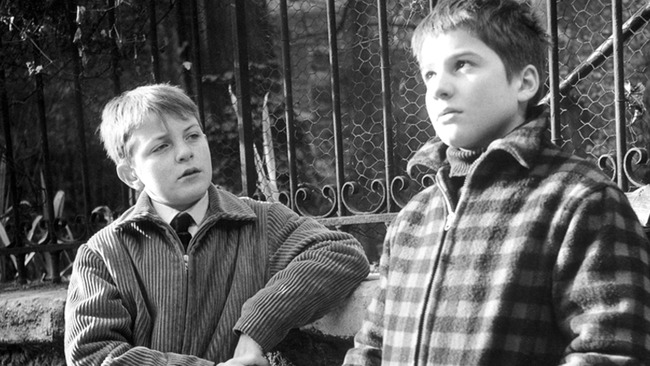
Whilst La mort de Louis XIV is not Léaud’s final film, (as it is already surpassed by four others), I cannot help but see this film as a bookend to his first – François Truffaut’s brilliant Les quatre cents coups; a film that continues to sing inside my breast long after my last viewing of it; and I would situate it amongst the very best of the French New Wave. Immensely touching but impossibly light. Liberty, youth, brotherhood are bounded in sensitivity and timelessness. There’s a certain feeling that’s intrinsic to all fourteen year olds, (as Guy Gilles rightly says in his films Love at Sea (1964), “you have to be very young to feel this” – also note the young Léaud has a cameo role in this film), that breathless ecstasy of adolescence, the abandonment of all ego or judgement, fuelled by a mix of daring and innocence. Truffaut has found the alter-ego of his childhood in Léaud; and whilst we are familiar with the story of how Léaud won the role of Antoine Doinel, (he was cast out of more than 400 boys who came to the casting call after Truffaut put an ad in the newspaper France-Soir, there’s a fantastic little audition clip that shows the young Léaud who had clearly skipped school and travelled all the way to Paris by himself for the audition; he was at once sweet, cocky and sure of himself). It is this exuberance, naïveté and arrogance that Truffaut managed to capture on screen that made this film so special. But more than that, Léaud was in many ways Doinel. This fictional character was created by Truffaut and Léaud through a further four films: Antoine and Colette (1962), Stolen Kisses (1968), Bed and Board (1970) and Love on the Run (1979). Note that all except for Stolen Kisses and Love on the Run are available to watch currently on Mubi.

A gaze of defiance and youthful dreams

Returning to Les quatre cents coups, the film opens with the unforgettable and heartbreaking score by Jean Constantin; we see passages of various neighbourhoods and streets of Paris through the window of a passing car with the Tour Eiffel always in the distant horizon. We wonder where this car’s traveller would take us; perhaps this is a jump forward to when Doinel was taken to the reformatory and the gaze is that of Doinel’s leaving a city he knows; well before his escape and his ability to redirect his gaze, to confronts us, his audience and judge. That semi-blurred freeze frame that ends the film, Truffaut’s young Doinel reminds me of the famous photograph of 16 year old Arthur Rimbaud by Ìätienne Carjat that I’ve grown to love so much. Of course, Doinel cannot be compared to Rimbaud in temperance or talent, but nonetheless, the two images share the same delicacy around the mouth and eyes to only be found in boyhood.

The semi-blurred freeze fame – ending the film in media res

“Faire les quatre cents coups” is a French saying that literally means “to cause trouble in every possible way”, and that is how society and those associated with its regulators would see of Antoine. The title is more a critique of those types of enforcements and agencies of authority. Instead, this film is a heady mixture of a vulnerable time in life, a youth who is coming to his own, often misunderstood, the lack of guidance from figures of trust, and the love-hate relationship with his parents propelled him towards his own search for identity. As a semi-autobiographical film, Truffaut’s lens is not clouded with sentimentality, having ditched the conventions of cinema from the forties and fifties, novelle vague reinvented ways of storytelling, jump cuts, filming on the street, non-diegetic inserts, and improvised scenes. All this presented Truffaut et al to capture the esprit of that time; those fleeting moments before a child becomes a man; that very fragile husk of freedom before one becomes accepting of the life one needs to lead (or sometimes reject).

It’s easy to see why so many (myself included) seek a different life in the darkened theatre, where something bigger-than-life enfolds and carries us in it’s slipstream. These are dreams of a different nature, an offering up of alternatives to the disenchantments of life. And this brooding sentiment became fastened to the soixante-huitards; a manifestation that is still within our collective consciousness. Reminders of this spirit live on in the graffitied street corners around the 5th even today. To see them our hearts are opened once more. The revolution that never took place is actually a revolution that never ended. 

Are these the faces of May 68?

Rather than raising hell, Antoine leaves your heart to ache in shreds long after the word FIN appears on screen. 

The two films bookend what is a search for the truth in cinema. The cinéma vérité authenticity in both Serra’s and Truffaut’s film peels back the saturated layers of luxuries and complexities technology has brought to 21st century filmmaking. Let’s settle with the heartbreakingly observed poetry in the boy and the king. 

Balzac and Gitanes – the heady mix of boyhood

Both La mort de Louis XIV and Les quatre cents coups are currently showing on mubi.

#filmfestivaleveryday  #filmoftheday #jandnfilmfestival 

Design a site like this with WordPress.com
Get started