Deutschstunde | The German Lesson (2019) Germany

Directed by Christian Schwochow

Der Passfälscher | The Forger (2022) Germany

Directed by Maggie Peren

Sebastian Schipper’s Victoria with Laia Costa, Frederick Lau and Franz Rogowski (L to R).

There is a huge selection at this year’s German Film Festival including a curation of 5 films across 5 decades sponsored by the Goethe-Institut, featuring well-known classics like Volker Schlöndorff’s superb The Tin Drum (1969) – we actually named our dog Oskar (in part because it’s an great name, but also in part to recall the genius of Schlöndorff in said film). His 2014 two-hander Diplomacy with André Dussollier and Niels Arestrup, about an imagined negotiation to avert the destruction of Paris, was brilliantly acted and immensely engrossing even if the imagined events are a little too close to the truth (those interested should catch this on Google Play or Apple TV if you’ve not already seen it). The 5 films also included one of my favourite recent German films, Sebastian Schipper’s Victoria (2016), shot in a single take and over the course of a night, with brilliant performances by the gorgeous Spanish actor Laia Costa in her first lead role in a film, paired with the extremely prolific German actor Frederick Lau as well as Franz Rogowski, who has been dubbed ‘man of the hour’ currently on mubi.

The festival has also brought with it a slew of new German films, with many of them based on books or are based on real events, as with the two films that are to be reviewed here.

The German Lesson

The wonderful Tobias Moretti as Max and Maria Dragus as Siggi’s sister Hilke.

Let’s start by posing a question: ‘What are the joys of duty?’ If you were to compose an essay on this, how would you start your narrative?

For me, I would say that the key in unlocking this question doesn’t quite revolve around the idea of ‘joy’, and instead becomes reflexive: it is a question of how dutifully one would approach this task in the first place, and secondly, to what extent would our bind to duty exceed human tolerances of amorality. In other words, how do we know what is the right thing to do? 

Fatalistic times.

The lesson taught in this masterly film by Christian Schwochow (you should also try to catch his film Je Suis Karl (2021) on Netflix) is none other than a lesson on how to act in good conscience; and in the process, one hopes to learn the difference between duty and humanity. When seen through the eyes of the film’s young protagonist Siggi Jepsen (we find an incredible fresh talent in Levi Eisenblätter who must have been about twelve when he starred in this film) whose formative experiences during the war years would come to shape his own conscience, and subsequently, we find in him an urgent and irrepressible need to recalibrate his loyalties, or at least make sense of his actions, through the writing of this very personal story. 

Looking over the mud plains — you get a sense of the world.

Based on a seminal novel of the same name by Siegfried Lenz; written and published in 1968, this is a book that has remained in circulation and has stayed in the curriculum for Year 6 students in Germany. For the film, Schwochow’s mother Heide Schwochow adapted the screenplay. This is the sixth film that this mother and son pair have worked on together with Heide in the writer’s chair; and clearly, this is a rewarding collaboration. The same goes with Schwochow’s long-time cinematographer, Frank Lamm who has a singular ability to strike a balance between widescreen landscapes, of the untamable wilderness outside, and giving us arresting close-ups, of faces with eyes showing the wilderness within. 

A slightly older Siggi (Tom Gronau) with his stack of notebooks, and thereby lies his German Lesson.

The film opens with an unnamed young man sitting at a desk with other classmates, the only tell-tale sign of his identity and location is his shaved head: as an audience, we intuit that he’s in juvenile detention. Then the class is given the essay topic of ‘the joys of duty’. This young man’s inability to write even a single word led him into solitary confinement where he was finally able to pen his narrative. This is where the story of his childhood begins, and with it, our lesson on an uncharted course on the gross deference of humanity. In war, all that we hold dear gets tossed to the winds; and our world is caught in an unending war.

Ulrich Noethen as the uncompromising Jepsen.

Siggi’s father, Jens Ole Jepsen (Ulrich Noethen), is the solitary and taciturn policeman stationed at their remote German northern coastal community. And without another authoritative figure in the community, Jepsen takes his duties very seriously; he enforces them to the tee. This is his will to power, the power to dominate regardless of consequence, regardless of reason. His neighbour, Max, is an artist, and godfather to Siggi. Max is played by the wonderful actor Tobias Moretti – he was fantastic in the avant-garde Mack the Knife – Brecht’s Threepenny Film (2018) which I had the good fortune to catch on the big screen during the 2019 German Film Festival season. Max’s Expressionist paintings have been labelled ‘degenerate’ by the Nazis and Jepsen took pleasure in ordering his friend to stop painting. When that failed, he engineered his young son to spy on him; not realising that the bond between the two was stronger than his own bond with his son. Feeling humiliated, Jepsen had Max’s works unceremoniously and forcibly confiscated. 

Pairings…

The worst was still to come. The family fractures: Siggi’s sister Hilke (Maria Dragus), a mostly absent family member to whom he was the closest; continues to leave despite her love for him. His older brother Klaus (played by the handsome Louis Hofmann, star of the hit Netflix series Dark, and The Forger (2022)) deserts the army and is disavowed by his father; Max was the only one sympathetic to Klaus’ predicament.

Humanity vs. Duty

The enormous tension between the two father figures tears Siggi apart; his love and trust for Max was evident and his growing disloyalty to his own father meant that Siggi’s conscience is split between the two different ideas of duty. 

A duty which is more a ‘calling’ fuels Max’s drive; and his ability to see beyond the dull and swampy mud flats, where from its cesspool, lush paintings of light and colour emerge; with this inner vision, he’s able to steer Siggi into a bearable if not better presence of mind. And the other, a constructed form of duty which would only exist should one blindly obey its orders.

Siggi in paradise – the shrine of the times.

The contrast between the monochromatic tones of dead seafaring birds, small house rodents, sun-worn bleached skeletons, as well as bits of wings and feathers that Siggi amassed in a decomposing shrine, acts as a counterpoint to the stylised and colourful paintings by Max: the amassed tomb stationed by the opened windows, the paintings glued and taped back together are stuck onto the barren walls of an abandoned house. This is Siggi’s paradise. The mood of this film is reminiscent of Louis Malle’s beloved and very personal film Au revoir les enfants (1987), where the tidal instincts of what constitutes the right thing to do is clearly visible in the tender faces of the young school boys. Siggi is no different here despite their somewhat different circumstances.

The landscape of Schleswig-Holstein is wind-swept and bleak; this is where the mud sticks. In this infernal place, which idea of duty can be learnt?

The bond between the ‘father’ and the ‘son’

The Forger 

Based on Cioma Schönhaus’s memoirs, The Forger: An Extraordinary Story of Survival in Wartime Berlin, is indeed the extraordinary account of a young Jewish man’s means of survival during the second world war in Berlin. 

The very handsome Louis Hoffman as the ever nimble Cioma in The Forger.

The contrast between this film and Schwochow’s The German Lesson could not be more starkly different. A far cry from the sombre lesson of Schwochow’s film, instead, there is a kind of effervescence in Louis Hoffman’s portrayal of Cioma, and if not for it being a non-fictional account, one would find this tale to be a highly dubious one.

Cioma in his milieu

The lightness of fingers that is often associated with trickery or forgery is a character that imbues the film throughout. There is an almost blatant disregard for the serious nature or the dangers of war in Cioma’s world – nor did he seem to be too concerned about the ‘disappearance’ of his family. I have read reviews of the book which described it to be an ‘enjoyable’ affair, again (at least to me) this description rubbed against the grain of reality. Nonetheless, Hoffman’s delivery of the central character, as a brash twenty year old living off his charms by day and wits by night, who had a steady hand and a love of graphic design, was however, well acted. Jonathan Berlin who played his best friend Det, a tailor by trade was also nicely cast; they were kind with each other, and there was something delicate in their friendship that made their relationship believable – perhaps especially when seen through the lens of memory. They were well supported by a strong ensemble cast, with Nina Gummich (I last saw her in Babylon Berlin) as the landlady and Luna Wedler (fantastic in the Netflix series Biohacker and The Story of My Wife (2021)) as Cioma’s love interest, Gerda. 

A stolen moment of tenderness.
Trickery means hiding in plain sight.

Cioma continued to outsmart friends, acquaintances, his landlady, inspectors, the Gestapo; skipping from one abode to another; living day-to-day on ration stamps, he was however able to dine at expensive restaurants and clubs, even dressing in uniform as a German naval officer in order to seduce a love interest. His brazen attitude meant that his work as a self-taught forger suited him well; and in this vein, he was able to help forge hundreds of IDs and papers for Jews in hiding, and thus saving their lives. Eventually he too had to flee to Switzerland, first by bicycle and then by swimming across a bitingly cold lake to cross the border, where he remained working as a graphic artist until his death in 2015. He published his memoirs at the age of eighty-two in 2004. 

#german film festival is currently playing at selected Palace cinemas around Australia, finishing on the 19th June in Sydney, Byron Bay, Melbourne and Canberra; and 22nd June in Brisbane, Adelaide and Perth.
#filmfestivaleveryday #filmoftheday #jandnfilmfestival

Volker Schlöndorff’s superb The Tin Drum with the inimitable Oskar.

La mort de Louis XIV | The Death of Louis XIV (2016)   

Directed by Albert Serra

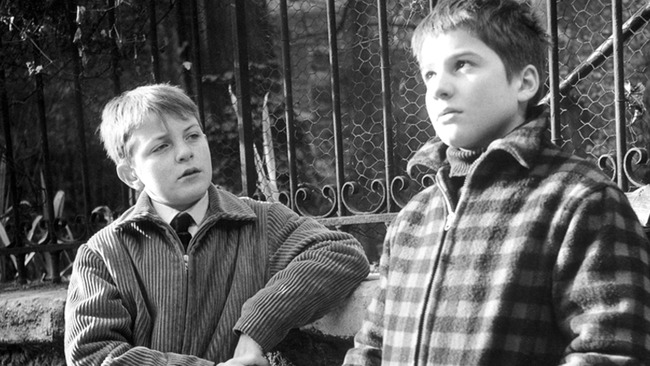
Les quatre cents coups | The 400 Blows (1959)   

Directed by the great François Truffaut

A photograph of Truffaut and Léaud taken in 1959.

On the eve towards one’s final destination, one is afforded a glimpse of a golden youth; those textures and colours so close in front of your eyes that they are made indiscernible from your present circumstance: this amber renaissance, where your vision fills with the yearning of yielding lovers whose lips and limbs curve about your body; thought-flights, high-rise, sunken dreams. You are no longer present. Because here, your eyes are myopic and your tongue is dried up and could only taste the thin veil of this chimeric vision. A temporal gulf that lies eternally between you and your beating heart.

Jean-Pierre Léaud is regal as King Louis XIV

Remembering Truffaut at the anniversary of his death – 21st October 1984, I watched two films on either side of that date. One by director Albert Serra, La mort de Louis XIV, and the other, his own unforgettable debut Les quatre cents coups; these two distant films fused together by a singular cinematic presence, that of Jean-Pierre Léaud.

The Sun King on his deathbed

Seeing the great Jean-Pierre Léaud laid out on his death bed as Louis XIV was a revelation. He exuded a sense of mortality we all feel at times, of that unspeakable destiny that awaits those who walk on this earth. The key operative that consoles the yawning abyss is conjured in the word ‘waiting’. It is certain that the idea of death is never too far away from one’s thoughts; even when holding an infant, their father already dreams of his child’s fate, of what lies ahead. The head of death darts up and although immediately extinguished, but we know all too well that it is simply lurking behind the sun. Into the shadows and vales of death, we must all turn. 

Physicians from the Sorbonne

Watching Léaud in La mort de Louis XIV, I saw the Sun King. But in him, I also saw the many incarnations of Antoine Doinel, Antoine’s youthfulness and misadventures has cast its glory days in Léaud’s lived-in face. Here, it is framed by high decorative wigs, his reclined body incumbent and inert is fully dressed, adorned in intricately embroidered brocade – oftentimes gold and crimson jacquard; and sometimes in French blue with gold details of an oriental landscape. He is always both cushioned and covered by dark wine-red velvet furnishings, an embossed pillows and coverlet. He is a feast for the eyes, despite the gruesome onset of gangrene that would eventually take his life (from a blood cot); first consuming his entire leg, it looked as though the King had donned a black stocking when in fact he was putrified from within. Nonetheless there is no mistaking that Léaud was Louis, and his wig is a lion’s mane. Perhaps this is what director Nobuhiro Suwa innately saw in Léaud when he casted him as veteran actor, Jean, in his very fine film Le lion est mort ce soir (2017). Even in these final days, there is a sense of arrogance and incredulity in his very defiance of death: Doinel had grown stately. 

A beautiful behind-the-scenes glimpse of Serra (to the left) at work.

Serra gave utmost care to the treatment of this film. He and his research team consulted physician’s texts, historical manuscripts in order to provide crucial measures of historic accuracy. This intimate retelling of the final days of Louis the Great, who died four days ahead of his 77th birthday on the 1st of September 1715 is a quiet and sombre affair. Louis XIV acceded to the throne at only four years and eight months of age and ruled France for a period of 72 years and 110 days, the longest of any monarch. The many facts of those last days and hours were taken from a specific source, from the memoirs of Duc de Saint-Simon in which the exact words spoken by the King on his deathbed were recorded. But during the edit of the film, all the dialogue was cut from those scenes, so that, in Léaud’s own words, “what you have are what precedes or succeeds them, and with that you’re left with that incredible intensity of the moment.” In that aspect, the dramaturgy came solely from Léaud’s stately presence, this is acting in micro-movements: the mood and tone created by a flicker of the lids, a prolonged gaze, grimaces or the sharp drawing of breath. Our approach to the great King in his reduced capacity is a more intimate affair; to read these diminutive traces that only the First Valet to the King, exquisitely played by Marc Susini, was able to discern and decipher. 

Here, Louis XIV talks to his 5 year old great-grandson of his imminent ascension to the throne echoing his own childhood and history
The First Valet to the King, exquisitely played by Marc Susini (middle)

This a grand film was shot on a small budget (less than $1M), and in 15 days without rehearsals. The methodology of Serra’s artistry demanded the actors be fully present in their various incarnations of this historical moment. And I for one, deem this piece of cinema to be a spectacle, including the singular prolonged moment of direct address, (and I’ve always loathed the breaking of the 4th wall – it most certainly didn’t work in Orlando (1992), or one of my favourite Christophe Honoré’s films Dans Paris (2006), in Amélie (2001) it was almost passable). I found myself strangely mesmerised by Léaud’s gaze, it was not the usual complicitness that many direct address want to extract, but instead, this gaze was invitational in tone, and perhaps it is the delicateness about his eyes that made this encounter more alluring. A fitting Kyrie from Mozart’s Mass in C Minor conducted by Helmuth Rilling with his Bach-Collegium of Stuttgart requests our presence to lock gazes with the King.

Léaud the grand

Unlike a modern take on Beckett’s Waiting for Godot, a good approximation to be found in Ashish Avikunthak’s wonderful film The Churning of Kalki (2015), where a continual deferral of the whatever it is you are searching for escapes you; Serra’s film provides a glimpse into the abyss rather than the infinite circumnavigation around its edges. This is an affecting reminder of what is lurking in our presence.

Léaud the innocent

Whilst La mort de Louis XIV is not Léaud’s final film, (as it is already surpassed by four others), I cannot help but see this film as a bookend to his first – François Truffaut’s brilliant Les quatre cents coups; a film that continues to sing inside my breast long after my last viewing of it; and I would situate it amongst the very best of the French New Wave. Immensely touching but impossibly light. Liberty, youth, brotherhood are bounded in sensitivity and timelessness. There’s a certain feeling that’s intrinsic to all fourteen year olds, (as Guy Gilles rightly says in his films Love at Sea (1964), “you have to be very young to feel this” – also note the young Léaud has a cameo role in this film), that breathless ecstasy of adolescence, the abandonment of all ego or judgement, fuelled by a mix of daring and innocence. Truffaut has found the alter-ego of his childhood in Léaud; and whilst we are familiar with the story of how Léaud won the role of Antoine Doinel, (he was cast out of more than 400 boys who came to the casting call after Truffaut put an ad in the newspaper France-Soir, there’s a fantastic little audition clip that shows the young Léaud who had clearly skipped school and travelled all the way to Paris by himself for the audition; he was at once sweet, cocky and sure of himself). It is this exuberance, naïveté and arrogance that Truffaut managed to capture on screen that made this film so special. But more than that, Léaud was in many ways Doinel. This fictional character was created by Truffaut and Léaud through a further four films: Antoine and Colette (1962), Stolen Kisses (1968), Bed and Board (1970) and Love on the Run (1979). Note that all except for Stolen Kisses and Love on the Run are available to watch currently on Mubi.

A gaze of defiance and youthful dreams

Returning to Les quatre cents coups, the film opens with the unforgettable and heartbreaking score by Jean Constantin; we see passages of various neighbourhoods and streets of Paris through the window of a passing car with the Tour Eiffel always in the distant horizon. We wonder where this car’s traveller would take us; perhaps this is a jump forward to when Doinel was taken to the reformatory and the gaze is that of Doinel’s leaving a city he knows; well before his escape and his ability to redirect his gaze, to confronts us, his audience and judge. That semi-blurred freeze frame that ends the film, Truffaut’s young Doinel reminds me of the famous photograph of 16 year old Arthur Rimbaud by Ìätienne Carjat that I’ve grown to love so much. Of course, Doinel cannot be compared to Rimbaud in temperance or talent, but nonetheless, the two images share the same delicacy around the mouth and eyes to only be found in boyhood.

The semi-blurred freeze fame – ending the film in media res

“Faire les quatre cents coups” is a French saying that literally means “to cause trouble in every possible way”, and that is how society and those associated with its regulators would see of Antoine. The title is more a critique of those types of enforcements and agencies of authority. Instead, this film is a heady mixture of a vulnerable time in life, a youth who is coming to his own, often misunderstood, the lack of guidance from figures of trust, and the love-hate relationship with his parents propelled him towards his own search for identity. As a semi-autobiographical film, Truffaut’s lens is not clouded with sentimentality, having ditched the conventions of cinema from the forties and fifties, novelle vague reinvented ways of storytelling, jump cuts, filming on the street, non-diegetic inserts, and improvised scenes. All this presented Truffaut et al to capture the esprit of that time; those fleeting moments before a child becomes a man; that very fragile husk of freedom before one becomes accepting of the life one needs to lead (or sometimes reject).

It’s easy to see why so many (myself included) seek a different life in the darkened theatre, where something bigger-than-life enfolds and carries us in it’s slipstream. These are dreams of a different nature, an offering up of alternatives to the disenchantments of life. And this brooding sentiment became fastened to the soixante-huitards; a manifestation that is still within our collective consciousness. Reminders of this spirit live on in the graffitied street corners around the 5th even today. To see them our hearts are opened once more. The revolution that never took place is actually a revolution that never ended. 

Are these the faces of May 68?

Rather than raising hell, Antoine leaves your heart to ache in shreds long after the word FIN appears on screen. 

The two films bookend what is a search for the truth in cinema. The cinéma vérité authenticity in both Serra’s and Truffaut’s film peels back the saturated layers of luxuries and complexities technology has brought to 21st century filmmaking. Let’s settle with the heartbreakingly observed poetry in the boy and the king. 

Balzac and Gitanes – the heady mix of boyhood

Both La mort de Louis XIV and Les quatre cents coups are currently showing on mubi.

#filmfestivaleveryday  #filmoftheday #jandnfilmfestival 

Design a site like this with WordPress.com
Get started